
• Hail, we're RedGuides. We want you to play six (yes, 6!) EverQuest characters at once. We have scripts and a friendly community to help, please join our playstyle and say hello! 👋
  • We've added LLM sections to our Terms & Rules and Resource Rules, for everyone's sanity & in-game safety.
    Read more
    a. Do not replace your voice with an LLM. This goes for your posts and your scripts. Drafting and editing with a tool is fine, but don't take you out of what you share.
    b. Do not replace your EQ character's voice with an LLM. We don't want scripts that speak over /ooc, /shout or other public channels. This has been an unwritten rule that's kept casino scripts off the site for decades, but we're now compelled to make it clear: keep automated communication private.

    Why Does RG Review Scripts?
    Nearly every LLM-written Lua script we see is making your character do impossible things, and rarely in a way that's beneficial to you. We've seen heavy server hammering, /target over impossible distances when /nav spawn would passively accomplish the same thing, a spawn search that fires 20+ times per second, and other pointless actions that are likely annoying GMs.

    You are welcome to use LLMs as a tool to structure, draft, and edit your work, but please read critically before hitting /lua run

Question - Functional difference of /vardata between MQ2 and Next

I have a support issue with one of my macros that basically boils down to a difference in how /vardata is working under MQ2 and Next. I can't really see why this would be an issue, so I'm looking for insight. I'd like it to work under both (at least for the time being), but long-term it'll be Next only.

To replicate the problem, I've created a small macro (code below and also attached).

OwnerPetTest
Code:
Sub Main
    /echo owner.ID ${Me.ID}
    /declare spawnId int local ${Me.ID}
    /declare owner spawn local
    /vardata owner Spawn[${spawnId}]
    /echo owner: ${owner}
    /echo owner.Pet: ${owner.Pet}
    /echo owner.Pet.ID: ${owner.Pet.ID}

    /if (!${owner.Pet.ID}) {
        /echo ${owner.Name} does not have a pet out, skipping
        /return FALSE
    }

    /declare targetPet spawn local
    /vardata targetPet owner.Pet
    /echo targetPet Type: ${targetPet}
/return

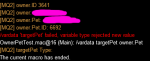
When running under Next, the output appears as
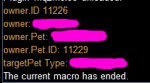
OwnerPetTest_Next.png

while under MQ2 it looks like

OwnerPetTest_MQ2.png
 

Attachments

In Next we added support for storing spawns via varset and vardata.

This is a new, highly requested feature from macro authors that MQ2 was unable to support due to huge flaws in its design and implementation.
 
spawn can be set via id as well, so if you have a spawn id stored as an int, you can vardata or varset that to a spawn type and it'll convert if its valid. Its a convenient way instead of ${Spawn[id #]}

We've done a lot of work to improve the usability of variables, but it isn't exhaustive. we fix things as we find it.

The issue with MQ2 was that a lot of things would appear to work, but would then just lead to unexplainable crashes later, or some things would flat out not work properly. We aim to fix those. If you encounter anything that doesn't work in MQnext we can investigate and see if its something we can fix or improve.
 
Yes, I'm aware I can use the spawn id in that way (and I do in my macro). I'm asking if spawn types are the only types which can be set via /vardata or can others be set as well (such as fellowship or race).
 
Question - Functional difference of /vardata between MQ2 and Next

Users who are viewing this thread

Back
Top
Cart